

No products in the cart.

 Krost
Krost Contact us





























Best 21V Batteries for Cordless Angle Grinders: Capacity & Compatibility
Cordless angle grinders rely heavily on battery power to deliver consistent cutting and grinding performance, and a weak or mismatched battery shows up immediately as reduced torque, inconsistent power, or a tool that simply can’t keep up with the job in front of you. Unlike drills, grinders draw serious current under load, which makes the battery choice behind them even more important than most people realize until they’re stuck mid-cut.
This guide covers how to choose the right 21V battery based on capacity and compatibility with your specific grinder, whether you’re replacing a worn-out battery that no longer holds a charge or picking up a spare so a longer job doesn’t grind to a halt halfway through.
Understanding 21V Batteries for Cordless Angle Grinders
You’ll often see these batteries marketed as 21V or sometimes 21V/37V MAX, and it’s worth understanding what that actually means before you buy. The number refers to peak voltage output rather than the battery’s resting or nominal voltage, and many “21V” branded batteries are actually built around 18V nominal cells that are marketed at their peak charge state. This is standard industry practice across most cordless tool brands rather than any kind of defect or false advertising, so don’t be alarmed if the actual voltage reads slightly lower once the battery settles under normal use.
Li-ion has become the standard chemistry across nearly all modern cordless angle grinders, replacing older nickel-based batteries because it charges faster, holds its charge longer when idle, and delivers more consistent power throughout a discharge cycle rather than tapering off unpredictably toward the end.
Battery Capacity Explained — What Ah Numbers Mean
Ah, or amp-hours, is the number that actually determines how long your battery lasts under real working conditions, and it matters more here than it does for lighter tools like drills.
How Capacity Affects Grinding Time and Power
A higher Ah rating means a longer runtime before you need to recharge, and the difference becomes very noticeable once you compare capacities side by side. A 2.0Ah battery might get you through light, occasional grinding tasks, while a 5.0Ah battery extends that considerably, and an 8.0Ah pack can carry you through extended, continuous cutting sessions without needing a mid-job swap. Since angle grinders draw significantly more current than a standard drill under sustained load, capacity plays a bigger role here in determining whether your tool maintains steady power or starts to lag as the charge depletes.
Choosing Capacity Based on Usage Type
If you’re grinding occasionally around the house for small repair jobs, a lower capacity 2.0Ah battery keeps things simple and the tool lighter in your hand without unnecessary bulk. But for frequent workshop use or ongoing metal fabrication work, stepping up to a 5.0Ah or 8.0Ah battery pays off quickly by cutting down on how often you’re stopping to recharge mid-project, which adds up over a full working day.
Best 21V Batteries for Cordless Angle Grinders
Here’s a practical breakdown of options across different capacity needs, from occasional home use to full-time professional workloads.
Best Entry-Level Capacity Option
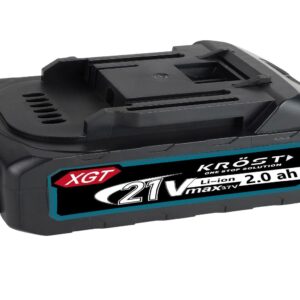
The KROST 21V (37V MAX) 2.0Ah PRO Series Li-ion Battery offers 2.0Ah/2000mAh capacity, well suited for lighter or occasional grinding tasks rather than sustained heavy use throughout the day. As part of the broader KROST PRO and X-Series lineup, it isn’t limited to grinders alone and can work across other compatible cordless tools in the same ecosystem. For home DIY users, this makes a sensible, budget-friendly option, either as a primary battery for light work or a backup pack kept ready for when the main one runs low.
Best for Extended Runtime
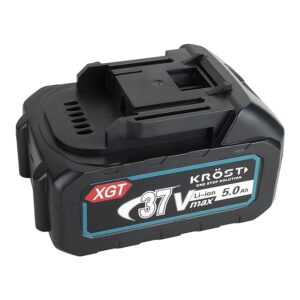
Stepping up in capacity, the KROST 21V (37V MAX) 5.0Ah PRO Series Li-ion Battery delivers noticeably longer runtime compared to the 2.0Ah option, making it a better fit for regular grinding or cutting sessions rather than occasional light use. It also supports quick-charge capability, reaching a full charge in around 2.5 hours, which helps minimize downtime between sessions. This makes it a strong pick for users who grind or cut regularly and would rather avoid interrupting a job for lengthy recharging breaks throughout the day.
Best for Heavy-Duty/Professional Use
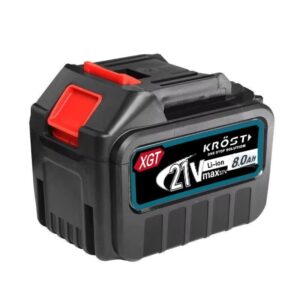
For continuous, demanding use, the KROST PRO SERIES 21V (37V MAX) 8.0Ah Li-ion Battery sits at the top of the capacity range, built for extended workshop or job-site sessions where recharging breaks simply aren’t practical. As with the other options, it remains part of the same PRO Series ecosystem, so it stays compatible across multiple KROST cordless tools rather than being limited to grinders alone. This capacity level suits professionals or anyone running their grinder for extended periods on a near-daily basis, where runtime matters as much as raw power.
Compatible Charger for 21V Batteries
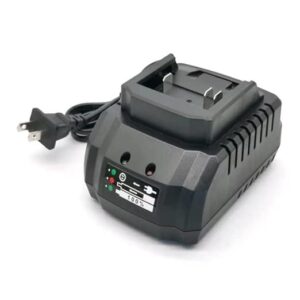
The KROST 21V 5.0A Li-ion Battery Charger is a charger rather than a battery, relevant if you already own a compatible battery but need a spare or replacement charging unit to go with it. With 21V DC output at 5.0A, it supports fast charging across compatible battery capacities in the same series. It’s a useful addition for anyone building out a backup battery and charger setup, particularly if you’re running multiple tools off the same cordless grinder battery platform and want redundancy in your charging equipment.
How to Extend the Life of Your Angle Grinder Battery
Good charging habits genuinely extend how long your battery performs at full strength before it starts noticeably degrading. Avoid overcharging by disconnecting the battery once it reaches full charge, and try not to let it fully drain repeatedly under heavy grinding loads, since deep discharges under high current draw put more strain on the cells than lighter, more moderate use would.
Storage matters just as much, especially in India’s climate, where leaving a battery in direct sunlight or inside a closed, parked vehicle during summer can expose it to heat levels that accelerate long-term degradation considerably. It also helps to let the battery cool down between heavy grinding sessions rather than immediately swapping in a fresh one and pushing straight through, since heat buildup from continuous hard use is one of the more common causes of premature battery wear.
Why Choose AtoZ Shop for Cordless Angle Grinder Batteries and Chargers
AtoZ Shop stocks the full KROST PRO Series battery ecosystem, covering various 21V cordless angle grinder models rather than a narrow, limited selection that leaves you guessing about fit. Ordering online comes with the reassurance of nationwide delivery, secure payment options, and an easy returns process if something doesn’t work out the way you expected once it arrives at your door.
Multiple capacity options are available under one platform, ranging from 2.0Ah for lighter use up to 8.0Ah for continuous professional work, along with compatible chargers to round out your setup. If you’re unsure which angle grinder battery capacity actually suits your grinding needs, customer support is available to help you work through the right choice before you commit to an order.
Conclusion
Choosing the right 21V battery really comes down to matching capacity to how intensively you actually use your grinder, along with making absolutely sure the battery and grinder share the same brand and series compatibility. A well-chosen replacement or spare battery keeps an otherwise perfectly good grinder running the way it’s meant to, rather than sitting idle because of a power issue that had nothing to do with the tool itself.
Before you buy, it’s worth checking both your grinder’s specifications and the battery ecosystem it belongs to, since getting that match right upfront saves you from returns, mismatched connectors, or a battery that technically fits but never quite performs the way it should.
FAQs
- Is a 21V battery the same as an 18V battery for cordless angle grinders?
Often, yes, in practical terms. Many 21V branded batteries are built around 18V nominal cells marketed at their peak voltage, which is common industry practice rather than a different underlying technology. - Can I use a 21V battery from one brand on a different brand’s angle grinder?
Generally no, since 21V batteries are typically brand and series-specific in both physical design and internal electronics. Always check compatibility with your specific grinder model before purchasing a battery from a different brand. - What Ah capacity is best for regular metal cutting and grinding work?
For regular or frequent use, a 5.0Ah battery usually strikes a good balance between runtime and practicality, while heavier daily workshop use benefits more from an 8.0Ah option. - How long does a 21V angle grinder battery last on a full charge?
This depends heavily on the Ah rating and how demanding your grinding task is, but a 2.0Ah battery typically lasts through lighter, shorter tasks while 5.0Ah to 8.0Ah batteries support extended, continuous sessions. - Can the same 21V battery be used for a drill, wrench, and angle grinder?
Yes, provided all three tools belong to the same brand’s battery ecosystem and series. This is one of the main advantages of investing in a shared 21V power tool battery platform rather than separate batteries per tool. - How much does a replacement 21V battery cost in India?
Pricing varies by capacity, with 2.0Ah batteries typically starting lower and 8.0Ah options costing considerably more due to the higher cell count and capacity involved. Checking current listings gives the most accurate picture. - Why does my angle grinder lose power even with a fully charged battery?
This can happen due to battery age, heat buildup during heavy use, or a compatibility mismatch between the battery and grinder’s electronics. Worn batteries also lose their ability to sustain peak current output over time. - How do I know if my charger is compatible with a higher-capacity battery upgrade?
Check that the charger’s voltage and series match the battery, and confirm the charger’s amp output can handle the higher capacity efficiently. Mismatched chargers may still charge the battery but far more slowly than intended.